
Florida Short Term Rental: Licensing, Insurance, And Tips For Hosts
Running a Florida short-term rental can be profitable, but it comes with real legal and financial responsibilities. You need the right licenses, proper insurance coverage, and solid management practices to protect your investment.
We at Responsive Insurance, Inc. created this guide to walk you through what you actually need to know. From state requirements to finding the right policy, we’ll cover the essentials that keep your rental operating smoothly.
What Florida Short-Term Rental Licenses Do You Actually Need?
State Licensing Requirements for Your Property
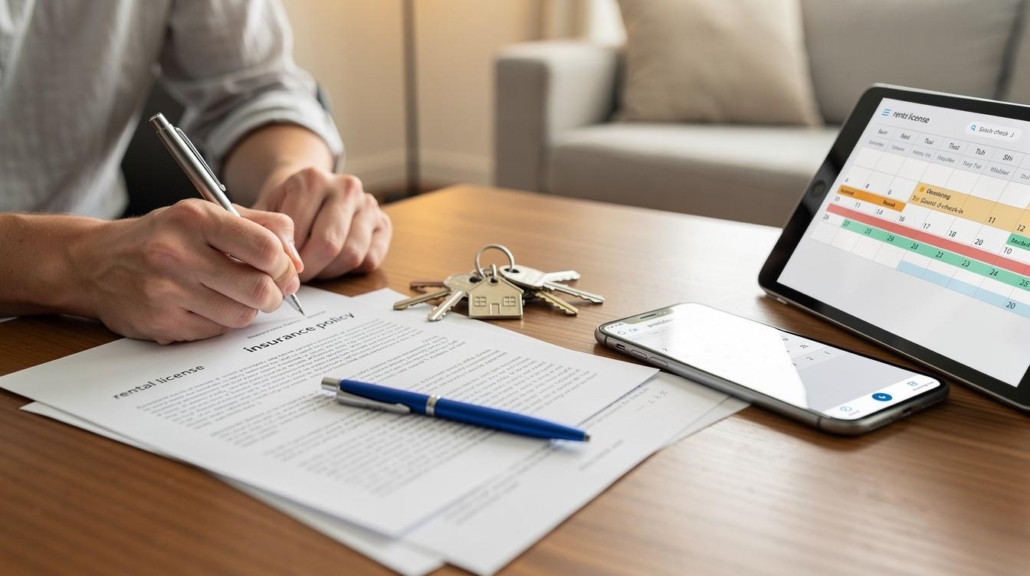
Florida requires short-term rental hosts to obtain a Vacation Rental license if you rent an entire property more than three times per year for periods under 30 days, according to Florida Statutes 509.242. The state classifies licenses as either Vacation Rental-Condominium or Vacation Rental-Dwelling, depending on your property type. If you rent individual rooms rather than entire units, you may not need a state license, but you should verify local requirements with your city or county. In Collier County specifically, registration becomes mandatory for unincorporated areas if you rent in increments of less than 30 consecutive days more than three times in a calendar year. Collier County Ordinance 2021-45 requires you to complete registration before you start renting, effective January 3, 2022.
How to Apply and What It Costs
The application process happens online through the Florida Department of Business and Professional Regulation (DBPR) Online Services account, with processing typically completed in one to two business days. Initial applications cost $50 for the application fee plus a $10 Hospitality Education Program fee, with license fees varying by county district and property capacity. For a single unit, you’ll pay $170 for a full year or $90 for a half year. Group licenses covering multiple units in one building cost $180 to $320 annually depending on unit count, while collective licenses covering up to 75 units across locations start at $150 plus $10 per unit. You must display your license publicly and include your Collier County Rental Registration Number in all advertising-print, radio, video, online, social media, and sharing platforms like Airbnb or Vrbo.
Compliance Obligations That Impact Your Operations
Once licensed, you face specific compliance requirements that directly affect how you operate. Florida law requires annual Human Trafficking awareness training for employees who handle housekeeping or front-desk duties, with new staff completing training within 60 days under Florida Statutes 509.096. Your property must meet fire safety standards including smoke detectors in every unit and hearing-impaired detectors at a rate of one per 50 rental units (maximum five per license), complying with NFPA 101 Life Safety Code. Baby cribs you provide to guests must meet Consumer Product Safety Commission safety standards.
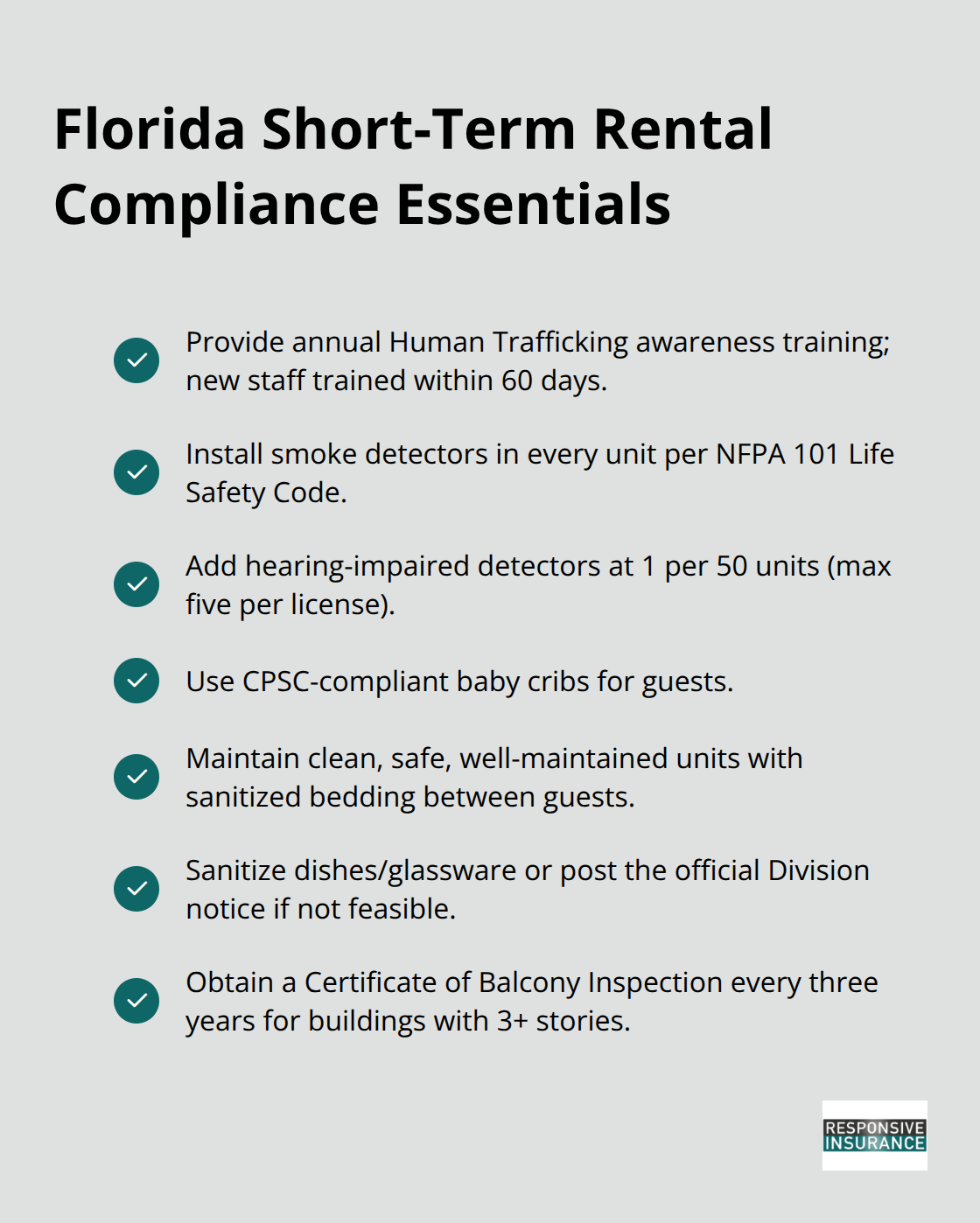
You must maintain clean, safe, well-maintained units with properly stored and sanitized bedding between guests. If you provide dishes or glassware, you’ll sanitize them using a three-compartment sink or commercial dishwasher between guests; if that proves infeasible, you’ll post the official Division notice. Additionally, buildings with three or more stories require a Certificate of Balcony Inspection every three years unless balconies are common elements.
Your Designated Responsible Party and Local Accountability
In Collier County, you must designate a Responsible Party available 24/7 by phone and able to be onsite within 24 hours if law enforcement or county violations occur. Changes to your Designated Responsible Party require a $50 non-refundable fee and you must report them within 10 business days. Failure to complete registration or maintain compliance can result in fines up to $500 per violation per day under Collier County Consolidated Code Enforcement Ordinance 2010-04. Your rental registration must be completed before you accept your first guest-incomplete applications are not accepted.
With your licensing and compliance obligations in place, the next critical step is securing the right insurance coverage. Standard homeowners policies won’t protect your rental income or cover guest-related incidents, which is why short-term rental insurance fills essential gaps that could otherwise leave you financially exposed.
Insurance Coverage for Short-Term Rental Properties
Why Your Homeowners Policy Won’t Protect Your Rental Business
Your standard homeowners insurance policy explicitly excludes business use, which means hosting guests for payment voids your coverage entirely. Most homeowners policies protect primary residences, not income-generating properties. If you file a claim after a guest injury or property damage while renting, your insurer can deny the entire claim and potentially cancel your policy. Airbnb and Vrbo provide host protection programs, but these have strict limits and significant exclusions. Airbnb’s Host Protection Insurance covers liability, but only if the incident falls within their specific coverage guidelines. Vrbo’s Host Protection offers similar limits but excludes certain types of damage and requires you to follow their exact procedures. These platform protections also do not cover your lost rental income if your property becomes uninhabitable due to weather, fire, or guest damage.
The Florida Hurricane Risk Gap
In Florida’s hurricane-prone environment, this coverage gap becomes especially dangerous. If a hurricane damages your rental property, your homeowners policy may cover the structure, but platform protection won’t compensate you for the weeks or months you cannot rent while repairs happen. Short-term rental insurance fills this gap by covering property damage caused by guests and natural disasters like storms and fires, liability claims from guest injuries, and loss of rental income during periods when your property cannot be rented.
What Short-Term Rental Insurance Actually Covers
Short-term rental policies cover specific scenarios that standard homeowners policies and platform protections ignore. Guest property damage coverage protects against broken windows, damaged furniture, stained linens, and lost keys that guests cause during their stay. Liability coverage pays for medical expenses and legal costs if a guest is injured on your property and sues.
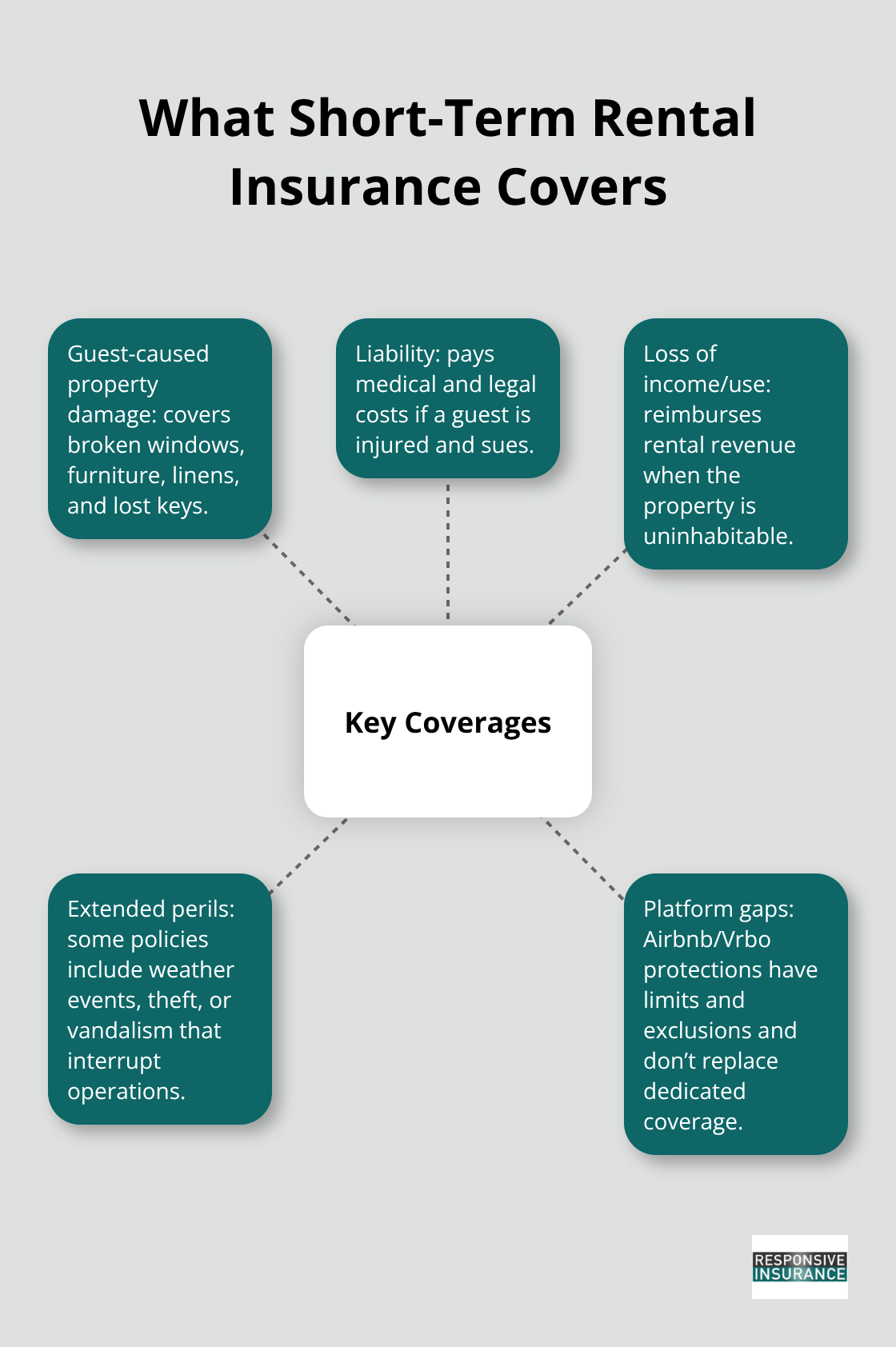
Loss of use or loss of income coverage reimburses your rental revenue if damage makes the property temporarily uninhabitable. Some policies extend to cover damage from weather events, theft, or vandalism that interrupt your rental operations.
How Insurance Costs Vary for Your Property
The cost of short-term rental insurance varies based on your property location, building construction type, fire risk in your area, natural disaster exposure, local crime rates, and the specific amenities you offer guests. A single-family home in a low-risk Naples neighborhood will cost significantly less to insure than a multi-unit property in a high-crime area. These factors directly impact your premium, so understanding your property’s risk profile helps you anticipate costs.
Finding the Right Coverage for Your Rental
A licensed agent who specializes in short-term rental coverage can identify which gaps exist in your current protection and recommend specific endorsements or additional policies that protect your actual rental business. Online quote forms cannot bind coverage or make changes to your policy, so speaking directly with an agent ensures you understand exactly what is and is not covered before a claim happens. With proper insurance in place, you can focus on the operational side of your rental-setting competitive rates, establishing clear house rules, and maintaining your property to keep guests satisfied and your investment protected.
How to Price Your Rental and Protect Your Property
Research Comparable Properties to Set Competitive Rates
Pricing your short-term rental correctly determines whether you maximize income or leave money on the table, and this decision directly impacts your bottom line. Check current rates on Airbnb, Vrbo, and Booking.com to understand what guests actually pay for similar square footage, amenities, and location. Price too high and you’ll sit empty; price too low and you’ll subsidize guest stays instead of building equity. Most successful hosts adjust pricing seasonally, charging premiums during peak winter months when Naples attracts visitors escaping cold weather, then dropping rates during slower summer months.
Target Occupancy Rates Over Nightly Rates
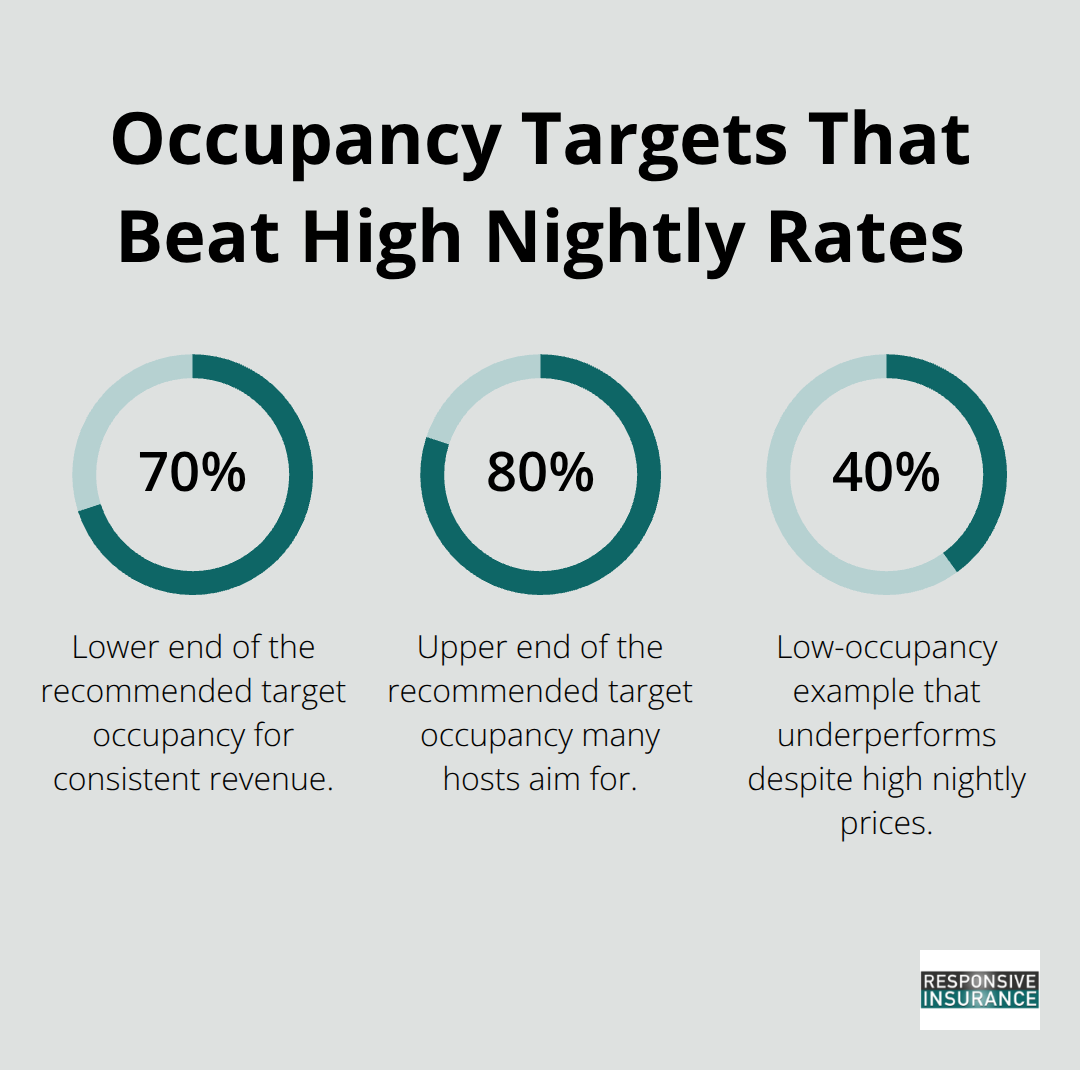
Occupancy rates matter more than nightly rates-a property rented 70 percent of the year at a moderate rate outperforms one rented 40 percent of the year at a high rate. Try to hit 70 to 80 percent occupancy as your target, then adjust from there based on actual booking patterns over three to four months. This approach builds consistent revenue without relying on unsustainably high nightly prices that keep your calendar empty.
Establish Clear House Rules Before Guests Arrive
Clear house rules prevent most guest problems before they happen, so spell out expectations in writing before guests arrive. State your exact check-in and check-out times, your noise restrictions and quiet hours, your parking rules, your occupancy limits per Collier County Code of Ordinances, and your pet policy if applicable. Require guests to acknowledge these rules when booking and send them again 48 hours before arrival so no one claims ignorance. This written documentation protects you if disputes arise later.
Maintain Your Property to Preserve Insurance Coverage and Rental Income
Maintenance directly protects your insurance coverage and your rental income-a property that fails inspection or has safety violations becomes unrentable and uninsurable. Schedule deep cleaning between every guest, inspect plumbing, HVAC, appliances, and electrical systems quarterly, and replace HVAC filters monthly since humidity and salt air in Florida degrade systems faster than in other regions. Document all maintenance in writing with photos and dates, which protects you if a guest claims damage you didn’t cause and your insurance company needs evidence of proper upkeep. This documentation also proves compliance with Florida’s requirement that you maintain units in clean, safe, well-maintained condition under Florida Statutes 509.096. Test smoke detectors monthly and replace batteries every six months to meet fire safety standards-a non-functional smoke detector voids your liability coverage if a guest is injured in a fire.
Conclusion
Running a Florida short-term rental successfully requires balancing three critical elements: state and local licensing compliance, adequate insurance protection, and operational discipline. You now understand that Florida Statutes 509.242 mandates licensing for properties rented more than three times annually for periods under 30 days, with Collier County adding its own registration requirements and designated responsible party obligations. Skipping this step exposes you to fines up to $500 per violation per day and potential legal liability.
Your standard homeowners policy will not protect your rental income or cover guest-related incidents, making short-term rental insurance non-negotiable. Platform protections from Airbnb and Vrbo have strict limits and exclusions that leave you financially exposed during hurricanes, guest injuries, or property damage. Proper coverage fills these gaps by protecting your property, your liability exposure, and your lost rental income when your property becomes temporarily uninhabitable.
On the operational side, competitive pricing based on market research, clear house rules communicated before arrival, and consistent maintenance schedules directly impact both your profitability and your insurability. A well-maintained property with documented upkeep demonstrates to insurers that you take risk seriously, which can lower your premiums and protect your coverage if claims arise. Contact Responsive Insurance, Inc. to discuss short-term rental coverage options tailored to your specific property and rental model.


