

NFIP Policy Alternatives: Exploring Private Flood Options
The National Flood Insurance Program has served homeowners for decades, but many in Naples are finding it no longer meets their needs. Rising premiums, restrictive coverage limits, and frustrating claim delays are pushing property owners to look elsewhere.
At Responsive Insurance, Inc., we’ve seen firsthand how NFIP policy alternatives can offer better value and faster service. This guide walks you through private flood insurance options and how to make the switch.
Why NFIP Coverage Falls Short for Naples Homeowners
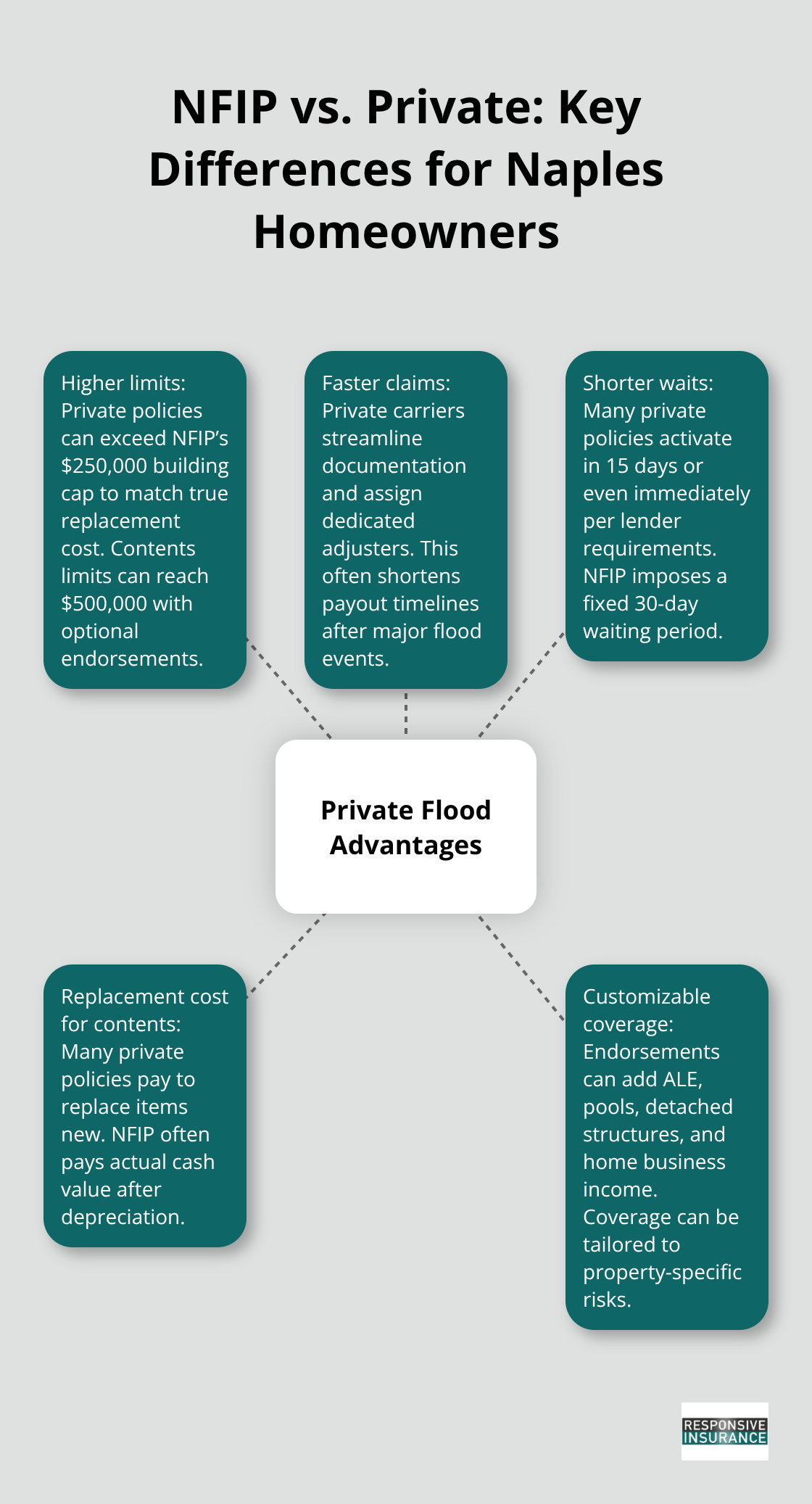
NFIP building coverage maxes out at $250,000 for single-family homes, and contents coverage tops out at $100,000. For many Naples properties, especially those in higher-value neighborhoods, these limits leave significant gaps. If your home is worth $500,000 or more, you face automatic underinsurance. FEMA implemented Risk Rating 2.0 in 2023, which prices flood insurance based on individual property risk rather than standardized rates. This shift has hit some Naples homeowners hard, with premiums climbing substantially for properties in flood-prone areas or with specific risk factors. The 30-day waiting period built into NFIP policies also creates a real problem: you cannot wait until a storm is forecast to buy coverage. Many homeowners do not realize this until it is too late, leaving them exposed during hurricane season.
Claims Processing Creates Real Delays
NFIP claims require extensive documentation and navigate a federal bureaucracy that slows payouts significantly. Private flood insurers typically streamline this process, getting money to homeowners faster when they need it most. After a major flood event, waiting months for claim resolution while living in temporary housing becomes unbearable. Private carriers often assign dedicated adjusters and provide clearer communication throughout the claims process. Additionally, NFIP policies frequently include actual cash value coverage for contents, meaning you receive depreciated amounts rather than replacement costs. If your five-year-old furniture suffers damage, NFIP calculates what it is worth today, not what it costs to replace it new. Private flood policies can cover replacement cost for contents, a critical difference when you rebuild after a flood.
Coverage Gaps That Matter
NFIP does not cover additional living expenses if your home becomes uninhabitable, forcing you to pay out of pocket for temporary housing, meals, and relocation costs. Private policies can include this coverage, typically around 20% of your home’s insured value. For a $400,000 home, that represents potentially $80,000 in coverage for displacement expenses. NFIP also will not cover pool repairs, business income loss, or damage to detached structures beyond basic building coverage. If you operate a home business or own valuable detached buildings, these exclusions create serious exposure. Private flood insurers offer endorsements that address these gaps directly, tailoring coverage to your specific situation rather than applying one-size-fits-all federal limits.
Why Private Policies Offer Better Flexibility
Private carriers price risk based on property-specific factors, potentially delivering better rates for certain properties than NFIP’s standardized approach. They can also combine NFIP and private options to tailor coverage to high-value or unique properties. If your building value exceeds the NFIP cap, you can purchase an excess coverage policy to achieve full protection. Private flood policies typically have shorter waiting periods than NFIP’s 30 days-some carriers offer 15 days or immediate coverage depending on your lender’s requirements. This flexibility matters when you want to act quickly without waiting months for coverage to activate.
The coverage limitations and processing delays of NFIP leave many Naples homeowners underprotected and frustrated. Understanding what private flood insurance can offer is the first step toward finding a solution that actually fits your property and your needs.
What Private Flood Policies Actually Cover
Private flood insurance fills the gaps that NFIP leaves behind, and understanding what you can actually get matters more than price alone. Standard private flood policies typically offer building coverage up to $1,000,000 or more, compared to NFIP’s $250,000 ceiling for single-family homes. This makes a real difference in Naples, where median home values in desirable neighborhoods often exceed $500,000. Contents coverage under private policies can reach $500,000 or higher, and critically, many carriers offer replacement cost coverage for contents rather than actual cash value. If your sofa costs $3,000 to replace today, you receive that amount, not the depreciated amount NFIP would pay. Private policies also commonly include additional living expenses coverage, typically around 20% of your home’s insured value, covering temporary housing, meals, and relocation costs if your home becomes uninhabitable. A $600,000 home receives roughly $120,000 in displacement protection. Beyond standard coverage, private carriers offer endorsements for pool repairs, detached structures, home business income, and other exposures NFIP simply will not touch.
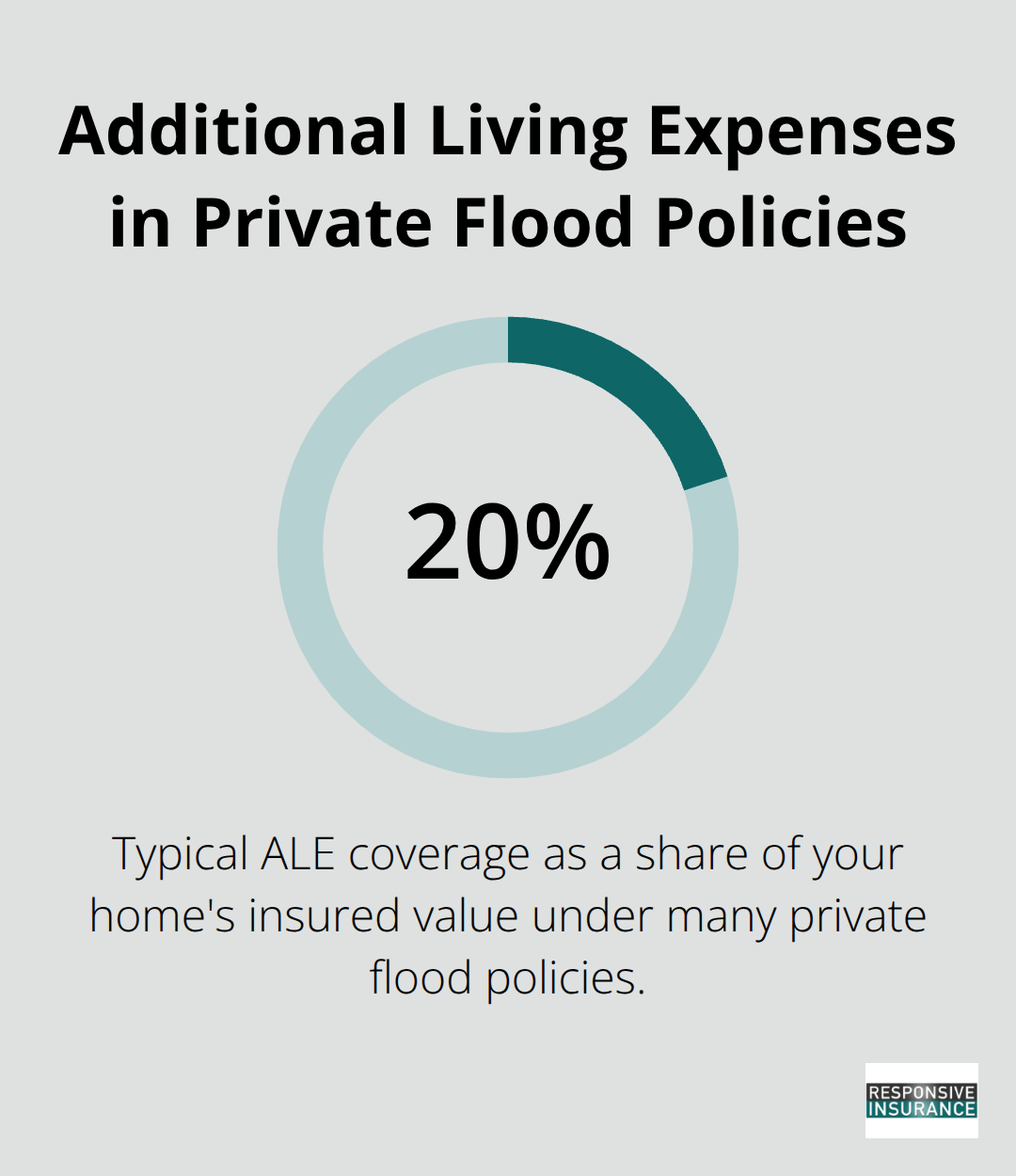
Waiting periods differ too-most private carriers activate coverage in 15 days or immediately, versus NFIP’s mandatory 30-day wait.
Excess Coverage Stacks Protection on Top of NFIP
If you already carry an NFIP policy but your home value exceeds the federal limit, excess flood coverage bridges that gap without forcing you to abandon NFIP entirely. This approach works well for Naples properties valued between $400,000 and $750,000, where the gap between replacement cost and NFIP limits creates genuine exposure. Excess policies activate only after NFIP pays its maximum, so you pay NFIP’s lower premiums for baseline coverage and add private excess protection for the remaining value. A $600,000 home with a $250,000 NFIP policy could carry a $350,000 excess policy for full coverage. The combined approach often costs less than switching entirely to private flood while delivering complete protection. Some carriers allow you to customize the deductible on excess coverage independently from your NFIP policy, giving you flexibility to balance premium costs against out-of-pocket risk.
Combined Homeowners and Flood Packages Simplify Administration
Bundling flood coverage with your homeowners policy through the same private carrier streamlines everything from billing to claims handling. When flood and homeowners coverage come from one insurer, you have a single point of contact, one renewal date, and coordinated coverage that eliminates overlap or conflicts. Private carriers can also offer package discounts (sometimes 10-15% off combined premiums), making bundled coverage more affordable than separate NFIP and homeowners policies. This integration matters most when you need to file a claim-a single adjuster familiar with your entire property situation processes damage faster than coordinating between multiple insurers. Bundled policies also allow carriers to write higher combined limits and add endorsements that address your specific property profile more comprehensively than NFIP’s standardized approach.
How to Evaluate What Matters Most
Coverage limits and flexibility matter far more than price alone when you select a private flood policy. A policy that costs $200 less annually but leaves $150,000 in building value uninsured creates far greater financial risk than the premium savings justify. Assess your actual replacement cost for your home and contents, then match that against available coverage limits from carriers you consider. Claims experience and support during recovery also factor heavily into your decision-a carrier that pays claims quickly and assigns dedicated adjusters proves its value when disaster strikes. Private carriers price risk based on property-specific factors (location, home value, chosen limits), so quotes vary significantly between insurers. Shopping multiple carriers reveals which one offers the best combination of coverage, cost, and service for your Naples property. An independent insurance agency can facilitate these comparisons and help you identify available discounts without requiring you to contact each carrier individually.
Making the Switch Without Losing Protection
Switching from NFIP to private flood insurance requires careful timing and clear understanding of what each policy covers, but the process is straightforward when you approach it systematically. Start by gathering your current NFIP policy details and request quotes from at least three private carriers through an independent agency. When comparing quotes, focus first on coverage limits rather than price-a $150 annual savings means nothing if you end up underinsured by $200,000. Request quotes that match or exceed your home’s actual replacement cost, not its market value. A $500,000 home might cost $550,000 to rebuild after catastrophic damage due to labor and material inflation, so your coverage should reflect that higher figure. Naples properties often see significant variation in private flood quotes because carriers price risk differently based on elevation, flood zone proximity, prior loss history, and specific property characteristics. One carrier might quote $1,200 annually while another quotes $1,800 for identical coverage limits-this variation makes shopping essential. Ask each carrier for a detailed explanation of their underwriting factors so you understand why prices differ.
Understanding What Exclusions Actually Mean
Read the exclusions section carefully because this determines what the policy will not pay when damage occurs. NFIP covers structural damage to walls, ceilings, and floors but excludes foundation cracks unless water actually enters the home. Private policies vary significantly on foundation coverage-some include it, others exclude it entirely. Ask your carrier directly: does this policy cover foundation damage from floodwater? Does it cover sump pump failure or backup? What about damage from water that pools in your yard but never enters the structure? These specific scenarios matter in Naples where heavy rainfall and poor drainage create localized flooding independent of major flood events. Contents exclusions differ too-NFIP excludes items stored in basements and attics, while private policies may or may not. If you store valuable items in your attic or basement, confirm whether the private policy covers them. Some carriers exclude business inventory or equipment even if you operate a small home-based business, while others cover it with an endorsement. Request the actual policy language, not just a summary, because marketing materials often oversimplify exclusions.
Timing Your Transition to Avoid Coverage Gaps
The 30-day NFIP waiting period creates a timing trap that catches many homeowners. If you cancel NFIP coverage today and purchase private flood insurance, the private policy typically becomes effective in 15 days or immediately, but you face a gap if the private carrier’s underwriting delays approval. Never cancel NFIP until your new private policy is actually in force and you have received written confirmation from the carrier. A common mistake involves assuming approval equals activation-it does not. Request written confirmation of your effective date from the private carrier before canceling NFIP.
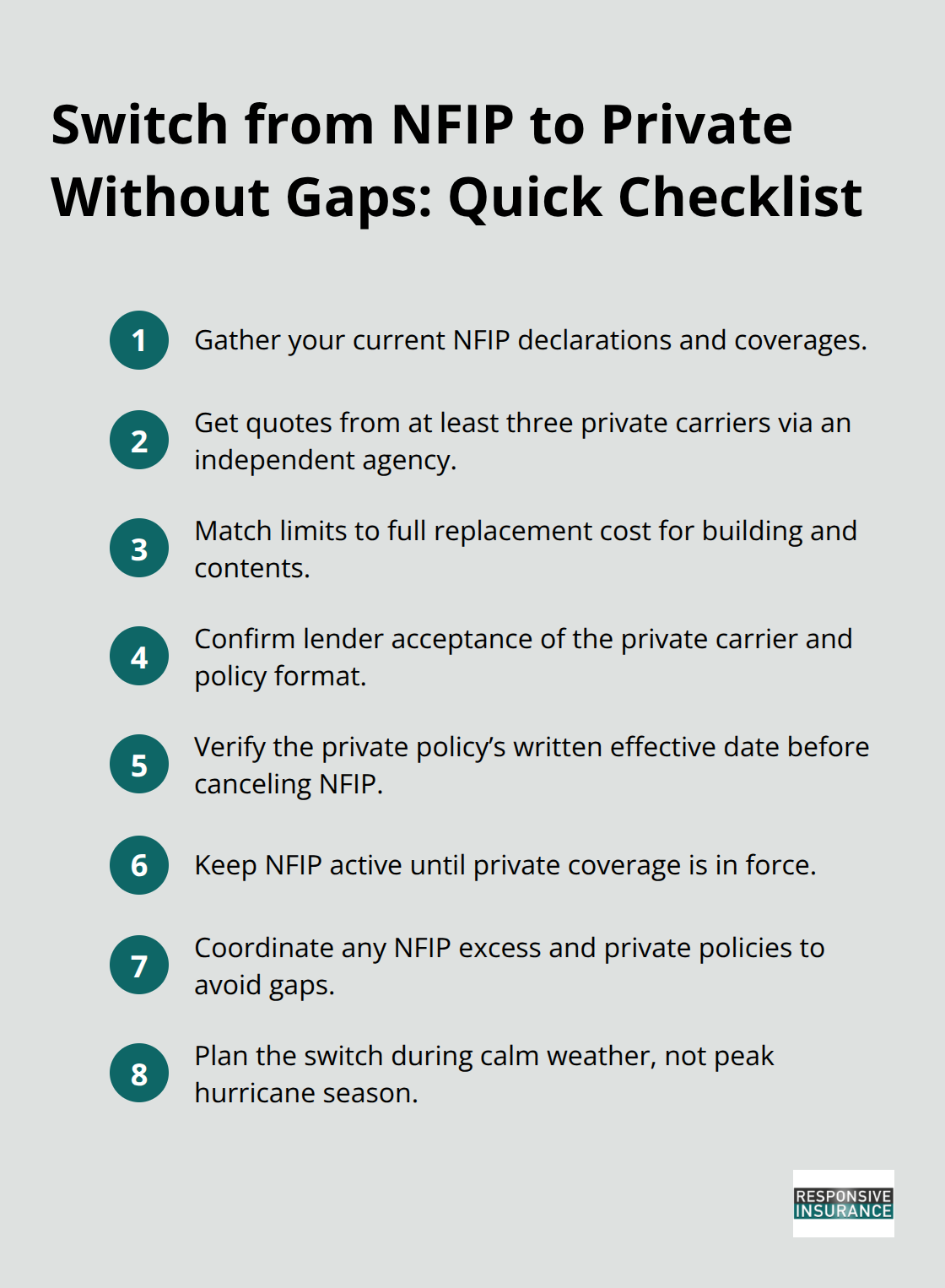
If you have a federally backed mortgage or loan, your lender may require continuous flood coverage, making gaps impossible. Contact your lender first to understand their requirements, as some lenders restrict which private carriers they accept or require a specific coverage format. If you currently have NFIP excess coverage paired with a private policy, coordinate the cancellation carefully-dropping NFIP while keeping excess coverage leaves you exposed because excess policies only activate after NFIP pays its limit. An independent agency can manage this coordination, ensuring your new private policy activates before old coverage terminates. The process typically takes two to three weeks from quote request to active coverage, so plan your switch during calm weather, never during hurricane season when approval timelines extend and coverage gaps become dangerous.
Final Thoughts
Private flood insurance offers Naples homeowners real advantages that NFIP simply cannot match. Higher coverage limits eliminate the underinsurance problem that affects most properties in our area, where home values regularly exceed NFIP’s $250,000 building cap. Replacement cost coverage for contents means you rebuild with new items, not depreciated amounts, and additional living expenses protection covers temporary housing and meals if your home becomes uninhabitable. Faster claims processing and dedicated adjusters get money to you when you need it most, not months later, while private carriers customize coverage for your specific situation with endorsements for pools, detached structures, and home businesses that NFIP excludes entirely.
Before you switch to NFIP policy alternatives, verify that your chosen private policy actually covers what matters most to your property. Read exclusions carefully, especially regarding foundation damage, sump pump failure, and items stored in basements or attics, and confirm your lender accepts the private carrier you select since federally backed mortgages impose restrictions. Never cancel NFIP until your new private policy receives written confirmation as active, because coverage gaps leave you completely exposed.
Contact an independent insurance agency to request quotes from multiple private carriers and compare your options. We at Responsive Insurance, Inc. work with multiple A-rated insurance companies to compare coverage and find the best fit for your specific needs, and our team can explain how private flood policies work and manage the transition from NFIP without creating coverage gaps. Reach out to us to explore your options and protect your home properly.


