
Florida Home Insurance Guide: A Step By Step Resource
Homeowners in Naples and across Florida face insurance challenges that don’t exist in other states. Hurricane season, coastal exposure, and strict regulations make finding the right coverage complicated and expensive.
We at Responsive Insurance, Inc. created this Florida home insurance guide to walk you through every decision you’ll need to make. From understanding why premiums are higher to discovering real savings opportunities, we’ll help you protect your home without overpaying.
Why Florida Homeowners Pay So Much for Insurance
Florida homeowners pay significantly more for insurance than the national average, and the numbers tell a stark story. Naples residents pay around $2,502 per year compared to the national average of $1,754 per year, according to Policygenius data. This 43% premium over the national rate reflects real, measurable risks that insurers face in the state. The primary culprit is hurricane season.

Florida has experienced destructive hurricane impacts that have driven homeowners insurance rates up approximately 35% over the last two years, forcing insurers to recalculate their exposure and adjust premiums accordingly.
Beyond hurricanes, Florida’s geography creates compounding problems. Coastal properties face storm surge and saltwater intrusion risks. Inland properties deal with flooding from heavy rainfall and poor drainage. Older homes with aging electrical systems and plumbing present higher fire and water damage risks. All of these factors stack on top of each other, which is why a $600,000 home near the water costs $9,000 per year to insure while a similar-valued newer home farther inland might cost only $2,000 annually. The difference between these two properties isn’t just about square footage-it’s about actual risk exposure that insurers must account for in their pricing.
Roof Age and Construction Quality Drive Your Rate
Your roof age matters more than you might think. Insurers favor homes built after 2005 with roofs under 15 years old, and this preference directly affects your premium. A newer roof signals lower wind damage risk, which is the dominant concern during hurricane season. If your roof approaches 15 years old, replacing it before shopping for insurance could save you thousands in annual premiums. This single improvement often produces the most dramatic rate reduction available to homeowners.
Deductible Choices Create Substantial Savings
Your deductible choice creates dramatic differences in what you pay. In Naples, a $500 deductible costs approximately $3,271 per year versus $2,046 per year for a $1,000 deductible, according to Policygenius. That $1,225 annual difference rewards you for accepting $500 more in out-of-pocket risk. Higher deductibles work well for homeowners who have emergency savings and can absorb unexpected costs without financial strain.
Dwelling Coverage Limits Determine Your Base Premium
Your dwelling coverage amount-the dollar limit on your home’s structure-is the single biggest premium driver. A $100,000 dwelling limit in Naples runs around $851 per year while $500,000 of coverage costs approximately $4,193 per year. Most Naples homes need higher limits, but understanding this relationship helps you make informed decisions about what coverage level actually makes sense for your property value.
Hurricane Deductibles Add Significant Out-of-Pocket Risk
Hurricane deductibles add another layer of complexity specific to Florida. Most policies feature a separate hurricane deductible that’s typically 2% of your insured value or a fixed amount around $12,000. This means a major hurricane claim could leave you responsible for substantially more than a standard claim. Knowing your hurricane deductible before disaster strikes is essential for understanding your actual financial exposure and planning your financial reserves accordingly.
Understanding these cost drivers positions you to make smarter decisions about your coverage. The next section walks you through the specific coverage options available to Florida homeowners and how to evaluate which types of protection actually fit your situation.
What Coverage Do You Actually Need in Florida
Florida homeowners must navigate a coverage landscape that’s fundamentally different from the rest of the country. Standard homeowners policies in Florida typically exclude or limit wind and hail damage, which means you cannot rely on basic coverage alone during hurricane season. This forces you to make active choices about additional protections rather than assuming standard coverage handles everything. The distinction matters because Florida insurers have carved out wind damage as a separate exposure, and you must either accept that gap or purchase windstorm coverage explicitly. This isn’t a minor detail-it’s a structural requirement that shapes your entire insurance strategy. You need to start by accepting that Florida requires layered coverage, not a single all-inclusive policy.

Flood Insurance Operates Outside Your Homeowners Policy
Flood insurance deserves special attention because it operates completely outside your homeowners policy. Your lender may require it if your property is in a high-risk flood area with a government-backed mortgage, and costs vary dramatically by location and coverage amount. Some carriers offer private flood insurance endorsements up to $5 million on top of homeowners policies, which provides valuable flexibility for coastal properties where standard flood insurance might not cover your full exposure.
Select a Deductible That Matches Your Financial Capacity
Deductible selection directly impacts your monthly affordability, and this choice should reflect your actual financial capacity to absorb losses. A higher deductible like $1,000 reduces your annual premium significantly compared to $500, but only if you genuinely have emergency savings to cover that amount after a claim. Don’t choose a higher deductible to save money if an unexpected $1,000 expense would strain your finances.
Align Your Dwelling Coverage Limit With Replacement Cost
Your dwelling coverage limit must align with your home’s actual replacement cost, not its market value, because insurers pay to rebuild, not to match what you paid. A $100,000 dwelling limit in Naples runs around $851 per year while $500,000 of coverage costs approximately $4,193 per year. Most Naples homes need higher limits, but understanding this relationship helps you make informed decisions about what coverage level actually makes sense for your property value.
Compare Quotes From Multiple Carriers
Rates vary substantially even for identical properties, making quote comparison essential rather than optional. State Farm, Tower Hill, Universal Property, and Slide Insurance all operate in Naples with different rate structures and risk appetites. Obtain multiple quotes from different carriers to reveal the actual price differences available to you. The next section walks you through cost-saving strategies that can reduce what you ultimately pay for the coverage you need.
How to Reduce Your Florida Home Insurance Costs
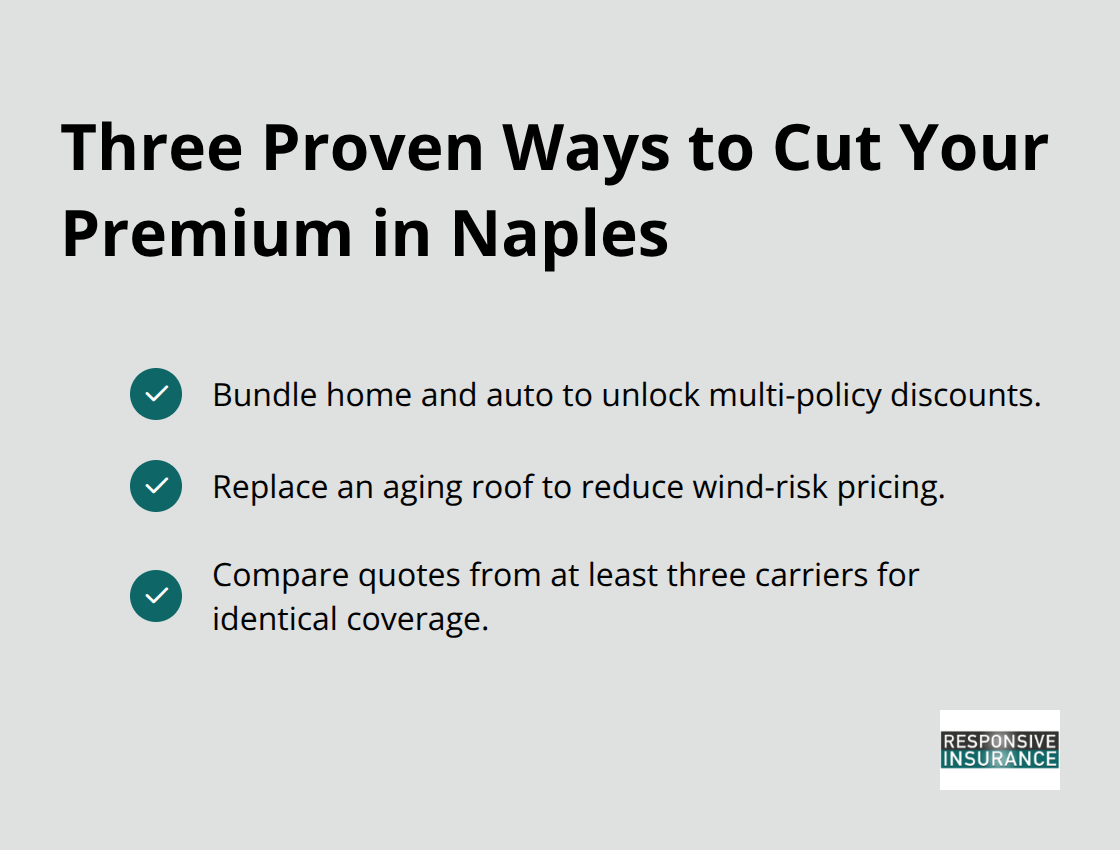
Reducing your Florida home insurance costs requires strategic action on three fronts: bundling your policies, improving your home’s risk profile, and comparing quotes across multiple carriers. Most Naples homeowners leave significant savings on the table by overlooking these opportunities. The difference between shopping strategically and accepting the first quote you receive can easily exceed $1,500 per year.
Bundle Your Policies for Immediate Savings
Start with bundling because it delivers the fastest win. Combining your homeowners policy with auto insurance typically reduces both premiums through multi-policy discounts. This approach works because insurers reward customer loyalty and reduce their administrative costs when they manage multiple policies for one household. The savings accumulate across your entire insurance portfolio, not just your home coverage.
Invest in Home Improvements That Lower Risk
Home improvements that directly signal lower risk to insurers produce measurable premium reductions. Roof replacement stands out as the single most impactful improvement because insurers heavily favor homes with roofs under 15 years old. A newer roof cuts wind damage risk, which is the dominant concern during Florida’s hurricane season. If your roof approaches that 15-year threshold, replacing it before your renewal can save thousands annually.
Beyond roofing, other improvements address specific risks that drive Florida rates higher than the national average. Installing a sump pump reduces flood risk and often qualifies for a premium deduction. Water heater replacement every 10 years and updated electrical wiring both reduce fire and water damage exposure that insurers price into your premium. These improvements work because they target the exact exposures that matter most to underwriters in Florida’s high-risk environment.
Compare Quotes Across Multiple Carriers
Quote shopping separates serious shoppers from those who accept whatever price appears first. Naples rates vary by ZIP code with some areas running $2,582 per year while others cost $2,434 annually for similar properties. Carrier differences matter even more than location. State Farm, Tower Hill, Universal Property, and Slide Insurance all operate in Naples with fundamentally different rate structures and underwriting appetites. A property that costs $3,000 with one carrier might cost $2,200 with another for identical coverage.
Never rely on your realtor’s estimate or the seller’s reported insurance costs when evaluating a property. Obtain actual quotes from at least three different carriers before making an offer or finalizing your coverage decision. Most insurers now offer online quote tools that require minimal information and deliver estimates within minutes. The effort of obtaining three quotes typically reveals at least $1,000 in annual savings compared to accepting the first quote. These savings compound year after year, making quote shopping one of the highest-return uses of your time as a homeowner.
Final Thoughts
Florida home insurance requires active decision-making at every step, and the effort you invest now pays dividends for years. Your premium depends on choices you control-roof age, deductible selection, dwelling coverage limits, and quote shopping all directly impact what you pay. A newer roof can save thousands annually, while a higher deductible reduces your premium substantially if you have emergency savings to cover unexpected costs.
Obtaining actual quotes from multiple carriers reveals price differences that often exceed $1,500 per year for identical coverage. Online quote tools deliver estimates within minutes, and the time investment typically uncovers significant savings. As you gather quotes, verify that your coverage includes explicit windstorm protection and evaluate whether separate flood insurance makes sense for your location and risk tolerance.
Working with a local agent transforms this process from overwhelming to manageable. An independent insurance agency like Responsive Insurance, Inc. works with multiple A-rated carriers to compare coverage options and find the best fit for your specific property and financial situation. Local agents understand Naples neighborhoods, know which carriers offer the best rates for your ZIP code, and can explain the nuances of Florida-specific coverage requirements that online quote tools sometimes miss.


