
Florida Homeowners Policy Guide: Demystifying Policy Language and Options
Florida homeowners face insurance requirements unlike anywhere else in the country. Your mortgage lender demands specific coverage, the state sets minimums, and policy language can feel overwhelming.
We at Responsive Insurance, Inc. created this Florida homeowners policy guide to cut through the confusion. You’ll learn what your coverage actually protects, how to compare your options, and what questions to ask before you buy.
Understanding Florida Homeowners Insurance Requirements
Why Florida Homeowners Pay More for Coverage
Florida homeowners face insurance costs that dwarf those in most other states. The average Florida homeowner pays more than three times the national average for homeowners coverage, and this gap exists for concrete reasons rooted in geography, regulation, and market dynamics.
Hurricane risk drives the core expense. Florida experiences more landfalling hurricanes than any other U.S. state, a reality that insurers price into every policy. Beyond wind damage, the state’s exposure to water intrusion, mold, and catastrophic losses means carriers shoulder substantial risk.
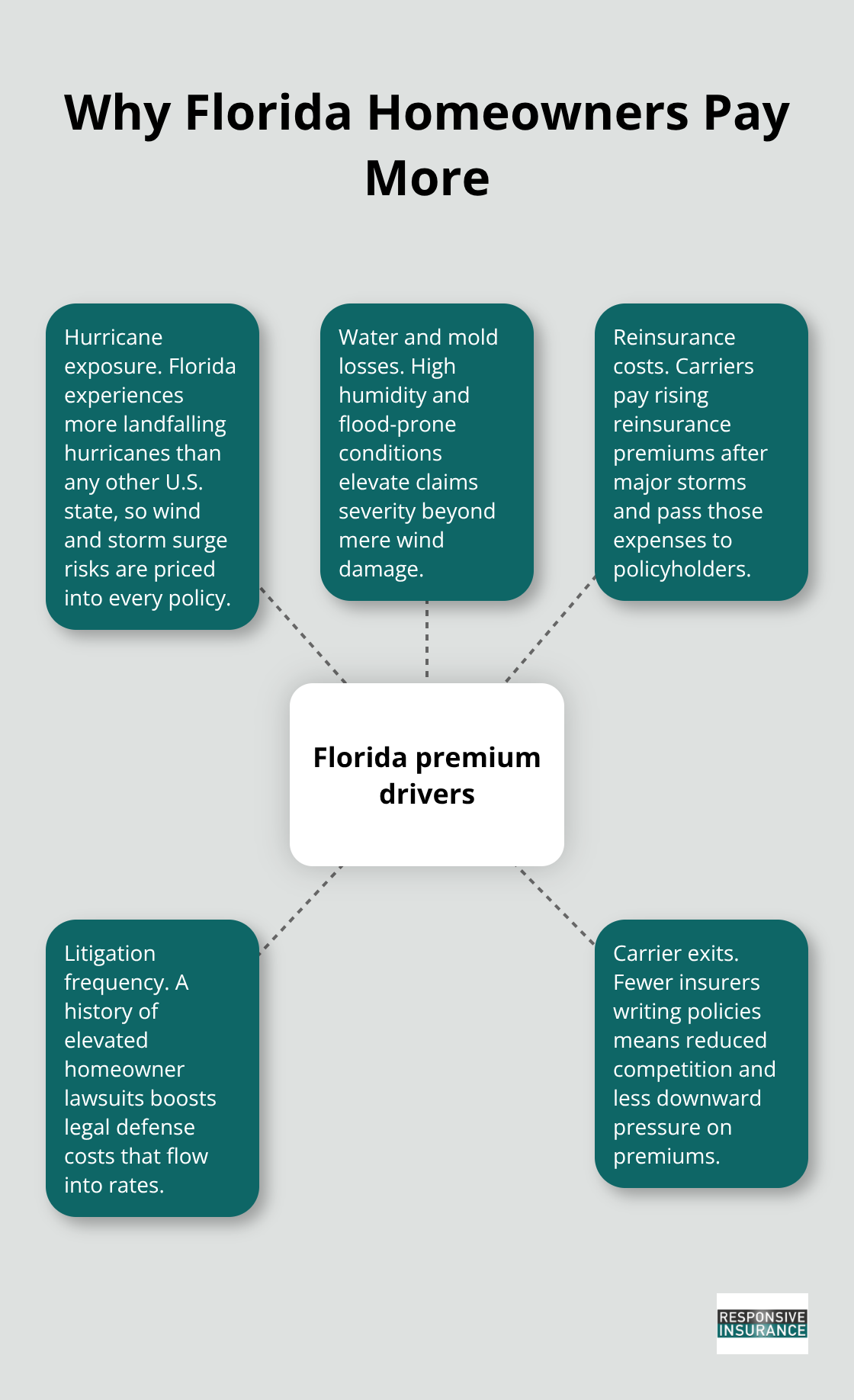
Reinsurance costs amplify this burden significantly. When major hurricanes strike, insurers purchase reinsurance to protect themselves against massive payouts. These reinsurance premiums have climbed steadily, and carriers pass those costs directly to policyholders.
Florida’s litigation history also inflates rates. The state has seen more homeowner lawsuits per capita than nearly anywhere else, and legal defense costs get baked into premium calculations across the market. Finally, carrier exits have reduced competition. When major national insurers withdrew from Florida in recent years, fewer companies remained to write policies, leaving less price pressure on the survivors.
These factors explain why a Naples homeowner might pay $2,000 annually for coverage that costs $600 in Georgia or North Carolina.
What Your Lender Actually Requires
Your mortgage lender imposes specific minimum requirements tied to the loan amount and property value. Most lenders demand dwelling coverage at least equal to the loan balance, sometimes higher. They also require liability coverage, typically a minimum of $100,000 to $300,000 depending on the lender’s risk appetite.
Lenders mandate that they be named as the loss payee on your dwelling coverage, meaning any claim payment goes to them first to protect their collateral. Some lenders add force-placed insurance if you let your policy lapse, automatically charging you for coverage you didn’t choose and probably overpaying for it.
Review your loan documents before shopping for insurance. Know your lender’s exact requirements so you don’t buy inadequate coverage or waste money exceeding what’s necessary. Contact your mortgage servicer directly rather than guessing based on industry standards.
State Minimums Versus Smart Coverage
Florida sets statutory minimums for homeowners coverage, but meeting the bare minimum leaves you dangerously exposed. The state requires only that your dwelling coverage equal at least 80 percent of replacement cost, a calculation that often underestimates true rebuild expenses in today’s market.
Replacement costs in Southwest Florida have climbed sharply, with labor and material inflation pushing rebuild budgets higher each year. If you suffer a total loss and insure for the statutory minimum, you’ll face a significant out-of-pocket gap between what insurance pays and what reconstruction actually costs.
Ordinance and law coverage, which pays the additional expense of rebuilding to current Florida building codes, is essential. Modern Florida codes require hurricane clips, impact-resistant windows, and upgraded electrical systems that older homes lack. Rebuilding without ordinance coverage forces you to absorb code-upgrade costs personally, often totaling tens of thousands of dollars.
Your liability limit matters equally. A $100,000 liability limit sounds substantial until a visitor suffers a serious injury on your property and sues for $500,000. Adequate coverage protects your assets and income from judgment claims.
Insure for full replacement cost of your home’s structure, carry at least $300,000 in liability protection, and include ordinance coverage as a standard endorsement rather than an afterthought. These decisions set the foundation for comparing specific policy options and understanding how different coverage types work together to protect your Naples home.
What Your Coverage Actually Protects
Dwelling Coverage and Structural Protection
Dwelling coverage pays to repair or rebuild your home’s structure if it suffers damage from a covered cause, but the policy language determines what counts as covered and what doesn’t. Many Naples homeowners assume dwelling coverage includes everything attached to the house, then face denials when the insurer argues that a detached garage, pool equipment, or outdoor structures fall outside the agreement. Your policy spells out exactly what qualifies: typically the main dwelling, attached structures like a garage, and built-in fixtures like kitchen cabinets and ceiling fans. Detached sheds, fences, and outdoor HVAC units often require separate endorsements or aren’t covered at all.
Walk through your policy’s dwelling definition before a loss occurs and ask your agent which structures on your property would actually receive coverage if damaged. This step prevents surprises when you file a claim.
Personal Property Limits and Sub-Limits
Personal property coverage protects your belongings inside the home, but it carries serious limits that most homeowners underestimate. Standard policies cap personal property at 50 to 70 percent of your dwelling limit, so if your home is insured for $400,000, your belongings might have only $200,000 to $280,000 of protection. Electronics, jewelry, artwork, and collectibles face additional sub-limits, often $1,500 to $2,500 per item.
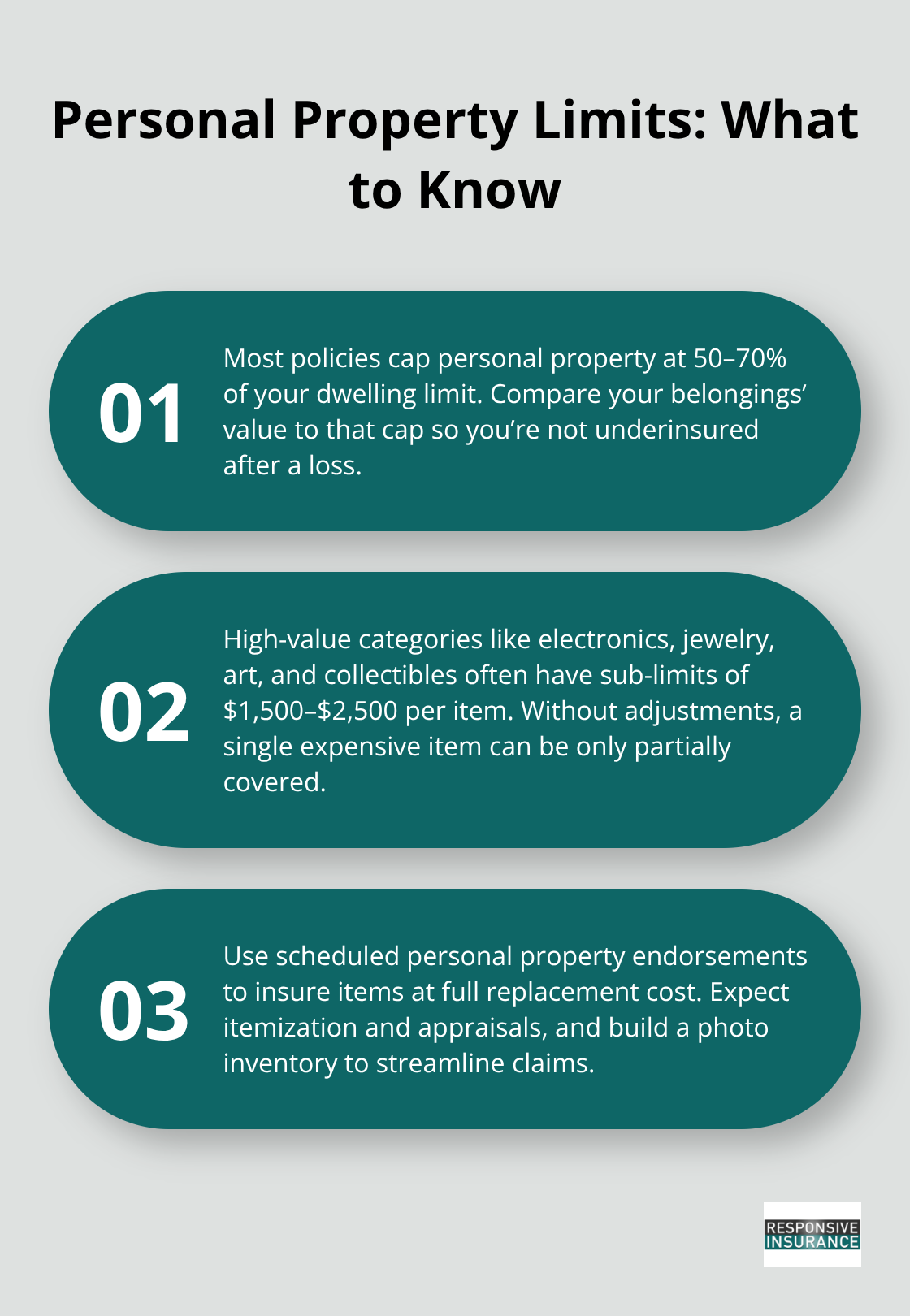
A single piece of jewelry worth $5,000 receives only $1,500 of coverage.
You can purchase scheduled personal property endorsements to insure high-value items at their full replacement cost, but this requires itemization and appraisals upfront. Create an inventory of your belongings now, photograph high-value items, and discuss scheduling endorsements with your agent if you own jewelry, art, or electronics worth more than the standard sub-limits.
Liability Protection Against Injury Claims
Liability coverage protects you when someone is injured on your property and sues for damages. A $100,000 limit sounds adequate until medical bills, lost wages, and pain-and-suffering awards exceed that amount, leaving your personal assets at risk. Florida juries award substantial damages in premises liability cases, making higher limits practical rather than excessive. Carrying $300,000 to $500,000 in liability protection is standard for most Naples homeowners, and the premium difference between $100,000 and $300,000 is typically only $50 to $100 annually.
Additional Living Expenses During Reconstruction
Additional living expenses cover hotel stays, meals, and other reasonable costs if your home becomes uninhabitable after a covered loss. Most policies limit this to 20 to 30 percent of your dwelling coverage, which may fall short if you face a lengthy reconstruction. A $400,000 home with $80,000 in additional living expense coverage sounds reasonable until rebuilding takes six months and hotel costs accumulate to $12,000 monthly. Review your policy’s additional living expense limit and verify it reflects realistic post-loss expenses for your household. Understanding these four coverage types sets the stage for comparing different policy forms and recognizing how replacement cost versus actual cash value affects what you ultimately receive after a claim.
Finding the Right Policy Form and Settlement Method
HO-3 Versus HO-5: Understanding the Coverage Difference
HO-3 policies dominate the Florida market because they balance cost and coverage reasonably well. They cover the dwelling on an all-risk basis, meaning any cause of loss is covered unless specifically excluded, while personal property is covered only on a named-peril basis, listing specific causes like fire, theft, and wind. HO-5 policies flip this approach: both dwelling and personal property are covered on an all-risk basis, eliminating the gap between what your home and belongings receive in protection.
For Naples homeowners, the choice between HO-3 and HO-5 hinges on whether you want uniform coverage strength across both dwelling and contents. HO-5 policies cost 10 to 20 percent more annually, but that premium difference vanishes instantly if a covered loss affects your belongings under a named-peril limitation in an HO-3. Water damage from a pipe burst, for example, covers your home’s structure under HO-3 all-risk dwelling coverage, but your soaked furniture and electronics might receive no coverage under the named-peril personal property section. HO-5 eliminates this inconsistency.
If you own substantial personal property or live in an older home where plumbing failures are realistic, HO-5 merits serious consideration despite the higher cost.
Replacement Cost Versus Actual Cash Value
The replacement cost versus actual cash value decision affects claim payouts more directly than policy form selection. Replacement cost value pays what repairs or replacement actually costs today, while actual cash value subtracts depreciation, sometimes paying only 30 to 50 percent of replacement cost for older items. A roof damaged by wind costs $15,000 to replace; under replacement cost, you receive $15,000; under actual cash value, you might receive $8,000 after depreciation is deducted.
Replacement cost should be your standard expectation for dwelling coverage in Florida, where rebuilding costs are substantial. For personal property, replacement cost adds 5 to 15 percent to your premium but prevents depreciation from gutting your claim payout when electronics, furniture, or appliances are damaged.
Discounts That Lower Your Premium
Bundling home and auto policies typically unlocks multi-policy discounts in the 5 to 20 percent range, often exceeding $300 annually for Naples homeowners. Wind mitigation discounts reward structural improvements like hurricane straps, impact-resistant windows, and roof reinforcement, sometimes reducing premiums by 10 to 45 percent depending on the upgrades documented in a professional wind mitigation inspection.
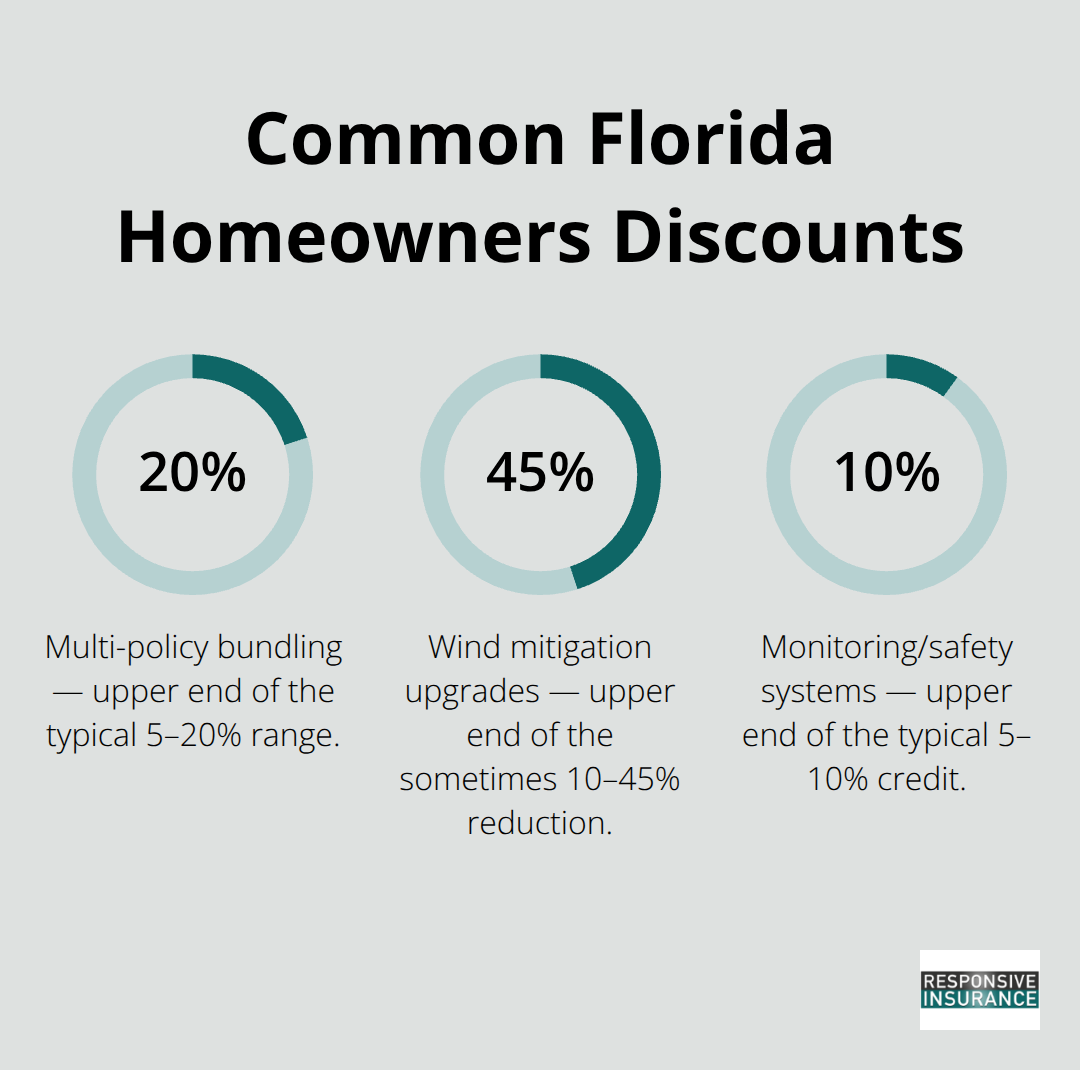
Monitoring systems, sprinkler systems, and smoke detectors generate smaller credits, typically 5 to 10 percent. Senior discounts (for named insured over 55) may apply automatically where eligible, though restrictions vary by program.
Questions to Ask Before You Purchase
Before purchasing, ask your agent whether your home qualifies for wind mitigation discounts, what specific upgrades your insurer credits, whether bundling with auto or umbrella coverage saves money, and whether senior discounts apply if you’re over 55. Request written quotes from at least three carriers showing identical coverage terms so you compare apples to apples rather than chasing the lowest price with inadequate protection.
As an independent insurance agency in Naples, Responsive Insurance, Inc. works with multiple insurance carriers to compare coverage options and help you find the right fit for your needs. Our team can review your specific situation, identify available discounts, and explain how different policy forms and settlement methods affect your protection.
Final Thoughts
Policy language determines what you recover after a loss far more than the dollar amount of damage itself. The decisions you make now-choosing between HO-3 and HO-5, selecting replacement cost over actual cash value, bundling policies for discounts, and documenting wind mitigation upgrades-directly affect what happens when a hurricane, water damage, or liability claim strikes your Naples home. Shopping around across multiple carriers matters equally, as premium differences of $500 to $1,000 annually are common when comparing identical coverage.
Start by pulling your current policy and reviewing the declarations page for your dwelling limit, personal property cap, liability limit, and deductible. Compare these numbers against your home’s actual replacement cost, your belongings’ value, and your risk tolerance. If your dwelling coverage falls below 100 percent of replacement cost or your liability limit sits at $100,000, adjust these limits immediately.
Schedule a wind mitigation inspection if you’ve made structural improvements in the past five years, since documenting hurricane straps, impact-resistant windows, or roof reinforcement can unlock substantial discounts. Contact Responsive Insurance, Inc. to review your coverage with an independent agent who works with multiple A-rated carriers and understands Florida’s unique insurance landscape. Our team in Naples can compare options across different insurers, identify discounts you might miss, and explain how specific policy language affects your protection.


