Auto Insurance Florida Tips: Save More Without Sacrificing Coverage
Florida drivers face some of the highest auto insurance costs in the nation. Between dense traffic, severe weather, and mandatory no-fault coverage, your premiums can climb fast.
We at Responsive Insurance, Inc. know that finding auto insurance Florida tips that actually work is tough. This guide shows you exactly how to cut costs while keeping the protection you need.
Why Florida Auto Insurance Costs So Much
Florida’s auto insurance premiums rank among the highest in the nation, and understanding why is your first step toward smarter coverage decisions. The state averaged around $3,707 per year for full coverage according to U.S. News data based on Quadrant Information Services, significantly higher than the national average. Three major factors explain this premium burden, and each one directly impacts what you pay every month.
Dense Traffic and Accident Risk
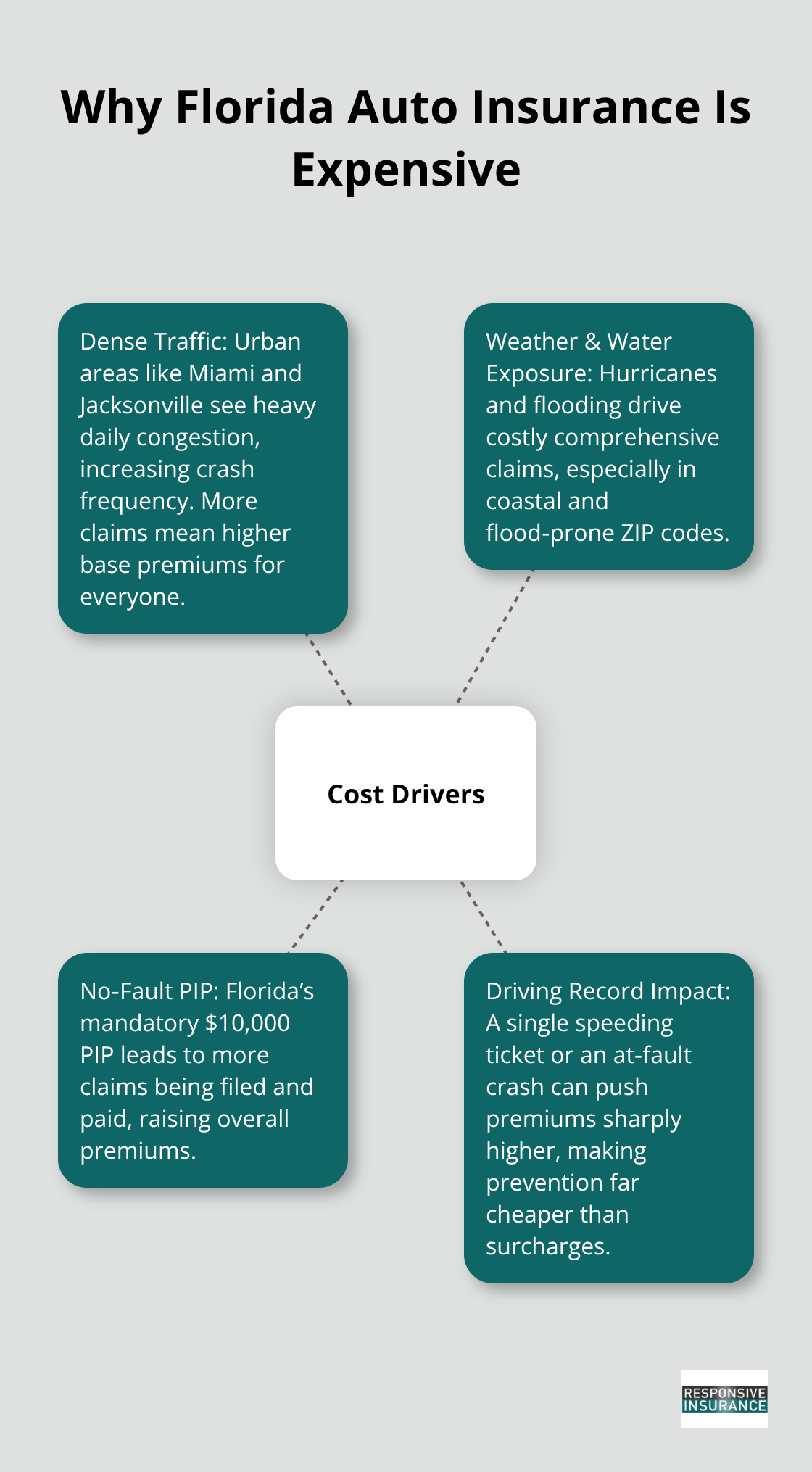
Florida’s population density creates constant collision risk. Miami, Jacksonville, and other urban centers experience heavy traffic daily, which drives up claims frequency. Naples itself reflects this trend, with full-coverage premiums averaging around $180 per month compared to the national full-coverage average of $168 per month. The more cars on the road, the higher your odds of an accident, and insurers price that risk into your policy.
Driving history amplifies this issue significantly. A single speeding ticket in Naples can raise your premium to around $2,220 annually with some carriers, while a clean driving record keeps you near the state average. An at-fault accident pushes rates to approximately $5,341 per year according to U.S. News data, making accident prevention far more cost-effective than paying higher premiums later.
Florida’s Weather and Water Exposure
Hurricane Milton caused approximately $34.3 billion in damage during 2024, and Florida has experienced numerous billion-dollar weather events since 1980. This reality forces insurers to price comprehensive and collision coverage at higher rates than states with milder climates. Coastal areas and flood-prone zones see even steeper premiums due to concentrated storm and water damage risk.
If you live in Naples ZIP codes like 34110 or 34120, your location directly influences your rate because these areas carry measurable flood and hurricane exposure. Comprehensive coverage becomes non-negotiable in Florida, not optional, if you want real protection against weather-related losses. The investment in this coverage protects your vehicle when storms strike.
No-Fault System and Mandatory PIP Coverage
Florida’s no-fault insurance system requires at least $10,000 in Personal Injury Protection (PIP) coverage, and this mandatory requirement increases your baseline premium compared to traditional fault-based states. PIP covers 80 percent of necessary medical expenses up to that $10,000 limit regardless of who caused an accident. This coverage protects you immediately but adds cost to every policy.
The no-fault structure also means more claims get filed and paid, increasing the overall claims burden that insurers pass along to consumers through higher premiums. Understanding this requirement helps explain why your Florida policy costs more than an identical policy in a neighboring state. Now that you know what drives these costs up, the real opportunity lies in identifying which strategies actually lower your premiums without leaving you exposed.
How to Cut Your Florida Auto Insurance Costs
Bundle Your Policies for Immediate Savings
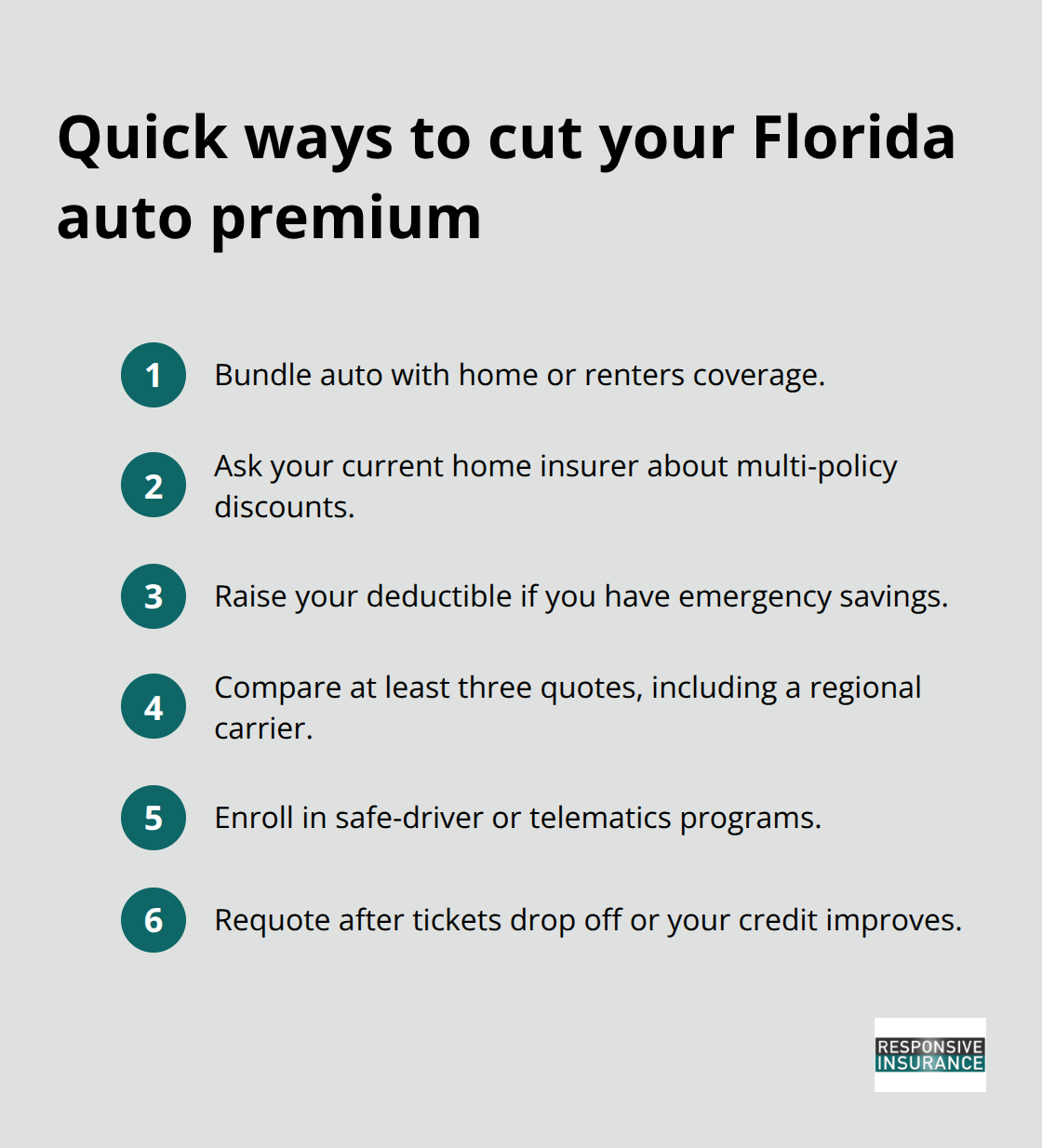
Bundling auto with home or renters coverage produces the fastest cost reduction available to most drivers. If you carry auto insurance separately from home coverage, you’re almost certainly overpaying. Multi-policy discounts can save you up to $1,429 when bundling auto and home insurance. In Florida, where full-coverage auto insurance averages around $180 monthly, a bundling discount can save you 10 to 25 percent depending on your insurer. That translates to $200 to $500 annually on auto alone-money most drivers never reclaim because they never ask.
Contact your current home insurer first to see what bundling discounts they offer. Many carriers provide substantial reductions when you consolidate policies with them. If your home insurer doesn’t offer competitive auto rates, shopping for both policies together at a new carrier often produces better overall savings than keeping them separate.
Adjust Your Deductible Strategically
Increasing your deductible from $500 to $1,000 lowers your monthly premium noticeably, though you’ll pay more out of pocket if you file a claim. The math works if you have emergency savings to cover that higher deductible. A driver with a clean record and modest annual mileage might reasonably jump to $1,000, saving perhaps $15 to $30 monthly. Over three years without a claim, that’s $540 to $1,080 saved while maintaining comprehensive and collision protection against major losses.
Your deductible choice should match your financial situation, not just chase the lowest premium. If an unexpected $1,000 expense would strain your budget, stick with the $500 deductible and look for savings elsewhere. The goal is reducing costs without creating financial stress when you need to file a claim.
Compare Quotes Across Multiple Carriers
Shopping multiple carriers matters more in Florida than most states because rate variation is extreme. State Farm averages around $1,279 annually in Naples while Geico sits near $1,426 and Travelers around $1,530 according to Policygenius data, yet these quotes apply to identical driver profiles. Your specific situation-your age, driving record, credit score, and vehicle-produces wildly different quotes across carriers. A single speeding ticket increases your rate differently depending on the company; State Farm might charge $1,392 while Geico charges $2,220 for the same violation. Poor credit pushes Geico premiums to around $2,494 versus State Farm at roughly $2,813.
These inconsistencies mean comparing at least three quotes is non-negotiable. Get quotes from State Farm, Geico, Travelers, and one regional carrier to see the full range of options available to you. Each company weighs your driving history, credit, and vehicle differently, so the cheapest option for your neighbor won’t necessarily be the cheapest for you.
Earn Discounts Through Safe Driving and Telematics
Safe driver discounts reward you for maintaining a clean driving record, typically offering 5 to 15 percent reductions on your premium. Telematics programs track your actual driving habits through your phone or a device and can yield similar savings if you drive safely. These programs work best for drivers who genuinely drive cautiously and can prove it through data rather than hoping their history speaks for itself.
Ask your insurer about both options when you get quotes. Some carriers emphasize safe driver discounts while others push telematics programs more aggressively. If you drive carefully and want to lower your rate, these programs give you concrete proof of your safe habits. Now that you understand how to reduce your costs, the next critical decision involves knowing which coverage types you absolutely cannot skip in Florida.
Essential Coverage You Cannot Afford to Skip in Florida
Personal Injury Protection Covers Your Medical Costs
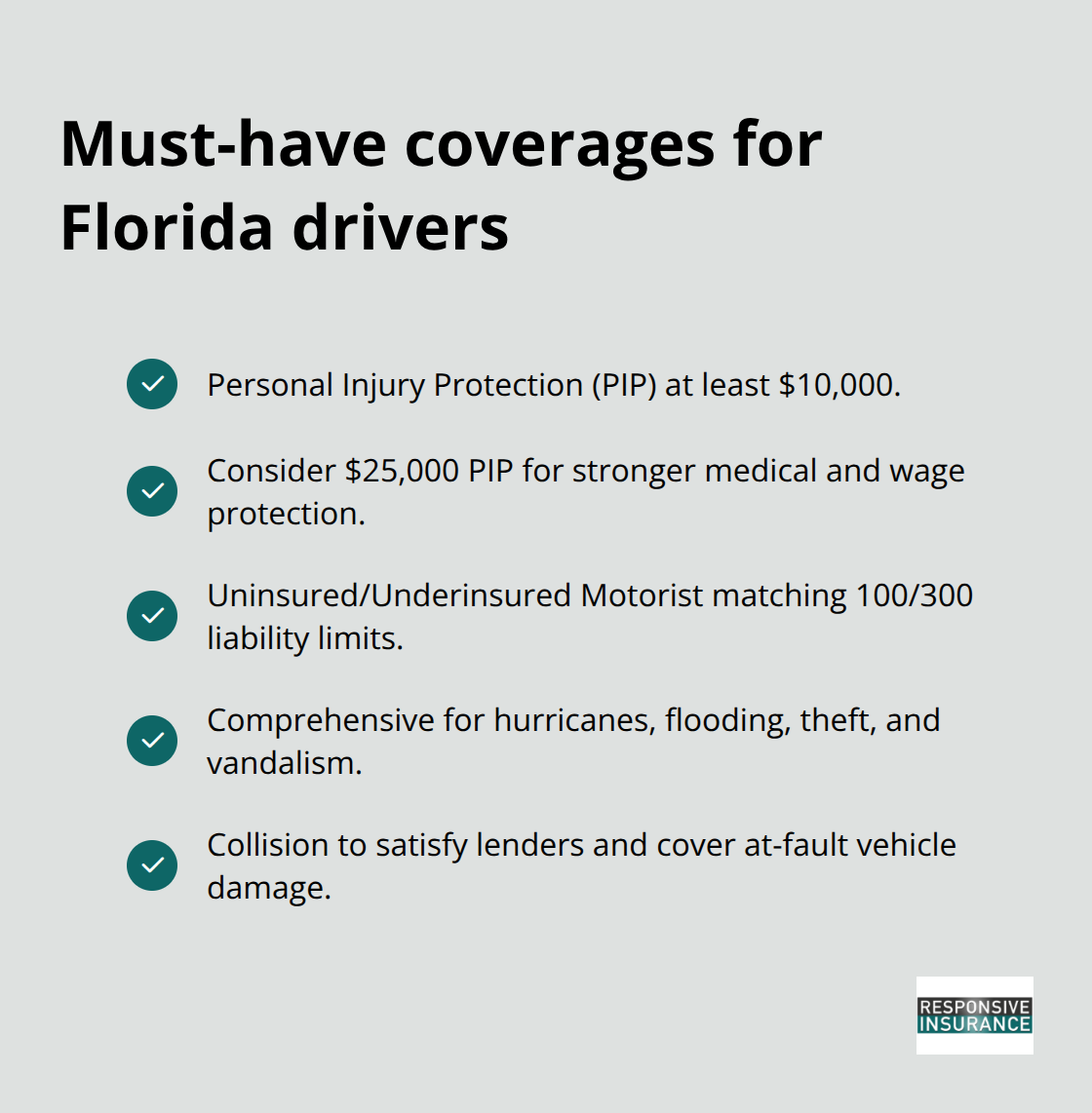
Florida law mandates that you carry at least $10,000 in Personal Injury Protection coverage, and this requirement exists for a reason-medical bills from car accidents spiral fast. PIP covers 80 percent of your necessary medical expenses up to that $10,000 limit regardless of who caused the accident, which means you receive treatment immediately without waiting for fault determination. This coverage protects you first, your passengers second, and pays for reasonable medical costs plus lost wages. The $10,000 minimum sounds adequate until you experience a serious injury requiring surgery, physical therapy, and time away from work. Most Florida drivers should carry at least $25,000 in PIP if they can afford it, especially if they have dependents relying on their income.
Uninsured Motorist Coverage Protects You from Other Drivers’ Gaps
Uninsured and underinsured motorist coverage fills a critical gap that PIP cannot address-it protects you when another driver causes an accident but lacks sufficient insurance to cover your damages. Florida has a substantial population of uninsured drivers, making this coverage far more than theoretical protection. If an uninsured driver causes $50,000 in damage to your vehicle and injures you seriously, your uninsured motorist coverage steps in to cover losses that the other driver cannot pay. Without this protection, you absorb those costs personally, potentially facing years of medical debt and vehicle repair expenses. Carry uninsured motorist limits matching your bodily injury liability limits-typically $100,000 per person and $300,000 per accident-to maintain consistent protection across all scenarios.
Comprehensive and Collision Coverage Protects Your Vehicle
Comprehensive and collision coverage protects your vehicle itself, not other people or their property. Comprehensive covers weather damage, theft, and vandalism while collision covers accidents with other vehicles or objects. Florida experiences frequent weather events, making comprehensive coverage essential rather than optional if you financed or leased your vehicle. Lenders require collision and comprehensive coverage as a condition of financing, but even if you own your vehicle outright, carrying these coverages makes financial sense given Florida’s weather exposure.
If you own a vehicle worth $20,000 or more, the monthly cost of comprehensive and collision coverage typically runs $40 to $80 depending on your deductible choice. Losing that vehicle to a hurricane or totaling it in an accident without these coverages would cost you thousands in replacement expenses. The math strongly favors maintaining comprehensive and collision protection for any vehicle you cannot afford to replace immediately from savings.
Final Thoughts
Finding the right balance between cost and coverage requires honest assessment of your financial situation and risk tolerance. Florida’s high premiums stem from real factors-dense traffic, severe weather, and mandatory no-fault requirements-that won’t change regardless of which carrier you choose. The auto insurance Florida tips covered here work because they address the actual levers you control: bundling policies, adjusting deductibles, comparing quotes, and earning discounts through safe driving.
A local Florida insurance agent changes this equation significantly by comparing quotes across multiple carriers simultaneously rather than asking you to shop individually. An independent agent understands Naples-specific risks like flood exposure in ZIP codes 34110 and 34120, hurricane frequency, and which carriers price those risks most fairly (they also know which companies offer the best discounts for your situation). This local expertise saves you hours of research and helps you avoid both overpaying for unnecessary coverage and under-insuring against real threats.
Your next step is straightforward: gather your current policy documents and contact Responsive Insurance, Inc. for a quote review. We’ll compare your existing coverage against what other carriers offer and identify immediate savings opportunities without sacrificing the protection you need. Most drivers discover they’re overpaying by several hundred dollars annually simply because they never shopped around or bundled their policies.


